
Watermelon Solidarity
On reclaiming, resistance, and responsibility (by Sean, Gentle Dispositions Nursery)

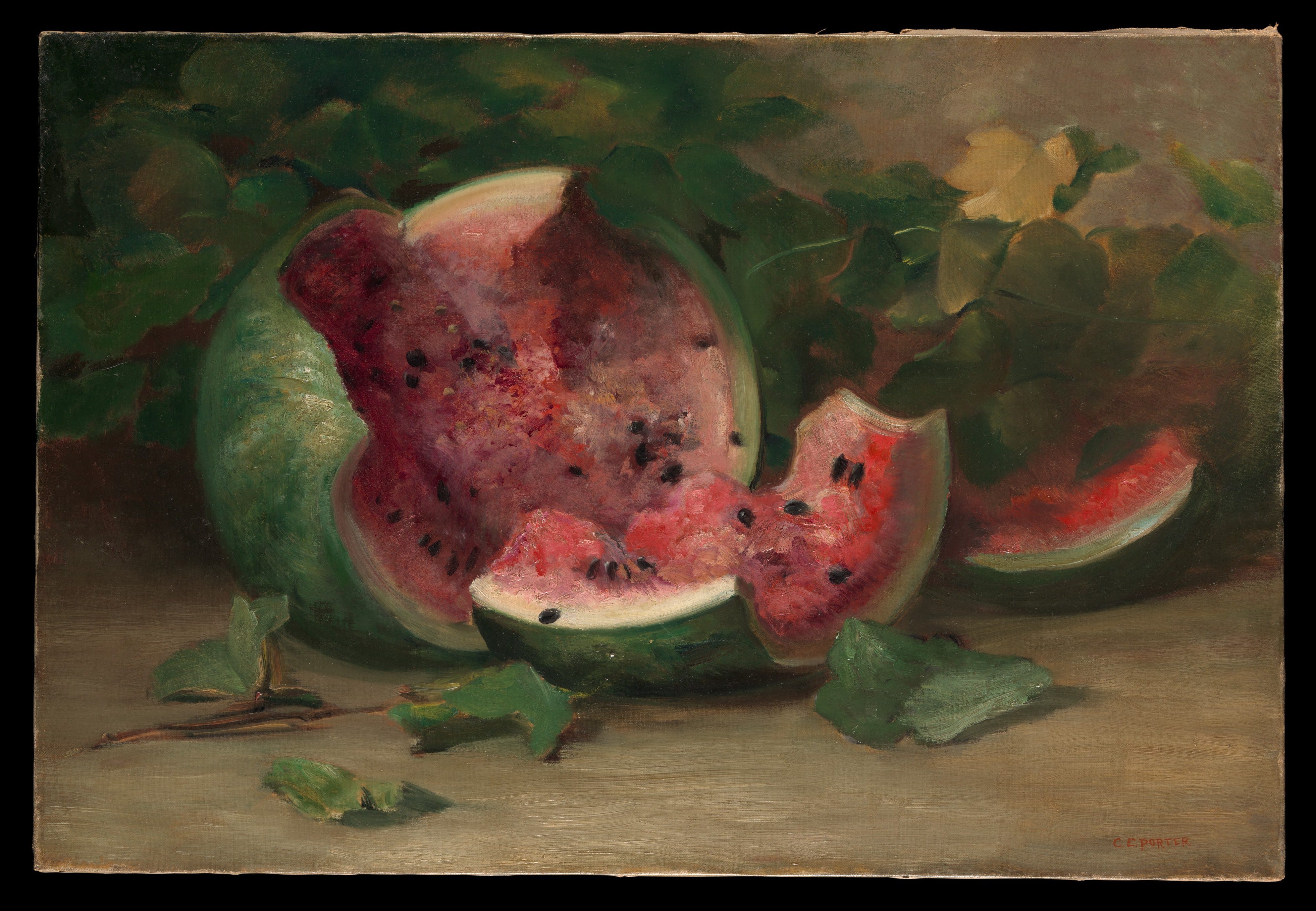
CRACKED WATERMELON
Around 1890, Charles Ethan Porter painted a still life of a watermelon, one of two paintings of the fruit the African American artist is known to have produced. The painting shows a deep green watermelon cracked apart into large chunks, revealing an inner world of reds and pinks dotted by luminous black seeds. Some of the pieces appear partially eaten.
Porter painted Untitled (Cracked Watermelon) when Jim Crow apartheid had just about finished dismantling the last vestiges of Reconstruction, robbing African Americans of the few material gains made during the period. The racist trope of watermelon-crazed African Americans had been circulating for over two decades by this point, and there’s no doubt Porter was aware of it. Porter’s reclamation, his reverent watermelon, defied the stereotype and the society that birthed it.
In William R. Black’s article “How Watermelons Became Black” he explains:
Freed people used watermelons to enact and celebrate their freedom, especially their newfound property rights. This provoked a backlash among white Americans, who then made the fruit a symbol of African Americans’ supposed uncleanliness, childishness, idleness, and unfitness for the public square.1
Even prior to emancipation, for enslaved African Americans freedom and watermelons were intimately linked. Laborers would weigh down cotton baskets with a hidden melon to meet quota and sell their garden melons to purchase themselves out of slavery. In the early 1860s, during the first years of the Civil War, the Sea Islands of South Carolina served as ground zero for an experiment in land redistribution, self-determination, and multiracial democracy. Here, watermelons factored significantly in African American attempts to avoid participation in the novel capitalist economy. As opposed to fulfilling Northern capitalists’ paternalistic ideas for how the post-slavery economy would function, African Americans wanted to “operate a sustainable subsistence economy” outside of capital’s reach.2 The growing and selling of watermelons was instrumental to that alternative system. Summer’s watermelon harvest was also accompanied by music and dance—occurrences that enacted vital moments of community building and care.
In response, white supremacists fired back a barrage of depictions of watermelon-eating African Americans that appeared in art, performance, and the press throughout the country. They often showed groups of African Americans sloppily and absent mindedly eating watermelons. Some showed them stealing the fruit, insinuating a lack of self-control. These depictions served not only to ridicule, but also to reinforce white society’s codes of conduct. The trope was so pervasive in popular culture that many African Americans stopped associating themselves with the fruit and avoided being pictured with it. In time the overt caricature diminished in popular culture, but the association never disappeared from public consciousness and remains present today.
Damaging as the trope was and is, it did not stop African American farmers from growing, selling, and importantly, enjoying and sharing the fruit. This context makes Porter’s painting all the more revealing and powerful today. It is also a fruit with deep heritage and history—much of which is grounded in Africa and the Near East. Here too we find watermelons used as means of resistance and reclamation, with Palestinians making watermelons a part of their struggle for self-determination.
SAVED AND WAVED WATERMELON
The known history of the cultivated sweet watermelon (Citrullus lanatus) begins in the Kordofan region of Sudan around 5,000 years ago. From there, the fruit moved through Egypt, into the Mediterranean, and then into Asia in the 600 and 700s. It was held in esteem for its medicinal properties, and in particular as a hedge against dehydration. The watermelon (which by then had likely been improved into countless varieties, named and unnamed) then made its way to the western hemisphere in the sixteenth century via enslaved Africans aboard Spanish colonists’ ships. Indigenous peoples subsequently grew watermelons on their land, and the fruit was grown in the gardens of the enslaved on the plantations and farmsteads of the colonies.
As such, while the cultivation of watermelons in the so-called United States is relatively recent, in the Near East watermelons have been a culinary and cultural staple for thousands of years. Yet here too the watermelon carried negative associations. William Black’s article notes that for eighteenth and nineteenth century Europeans, the watermelon was considered a “poor Arab’s feast.” Depictions of Mediterranean and Near East cities’ streets littered with melon rinds accompanied Orientalist associations between the fruit and the unrefined laboring class.
Fast forward to 1949 and Israel’s occupation of Palestine. The Nakba produced a cascade of tragedies, including the systematic undermining of Palestinian agriculture. Since then, “Israel has drowned the Palestinian agricultural sector with chemical pesticides, herbicides, and fertilizers. Likewise, it has advocated for a system of mono cropping that has left farmers vulnerable to middlemen who dictate prices and crop varieties.”3 The loss of heritage crop diversity has only accelerated in passing decades, leaving Palestinian agriculture all the more precarious and vulnerable to the pressures of occupation and climate change.
The Jadu’i watermelon has long been grown in Palestine. This variety was known for its large size and distinctive tan and black seeds. The curfews and restricted access to cropland that accompanied the First Intifada, however, nearly caused the Jadu’i to be lost. Vivien Sansour, founder of the Palestine Heirloom Seed Library, was able to track down some of the last known Jadu’i seeds and distributed them for planting. Unfortunately, genetic bottlenecking has resulted in smaller sized fruits than what was historically grown. Sansour has since shared the seed and its story with others outside of Palestine. In 2022, the Experimental Farm Network offered small packets of Jadu’i seeds, encouraging people to grow out a population that produces large fruit, helping to restore its legacy.
Such watermelon restoration in Palestine is an act of resistance that accompanies demands for self-determination. In this spirit, the water- melon has recently become an emblem for the Palestinian people, who emblazoned watermelons on banners and flags used during the uprising of 2021. The history of watermelon’s use in demonstrations begins after the Arab-Israeli War of 1967, when Israel banned the display of the Palestinian flag. It is reported that the pieces of watermelon—with its red, green, and black colors that mirrored those of the Palestinian flag—were then used as a subtle display of resistance to the rule. Later, artists in the 1980s attempted to display paintings of the Palestinian flag in a gallery, but military forces shut the show down and arrested the artists. One of the artists, Issam Badr, asked: “‘Well if I paint a flower with these colours, what will you do?” And the officer responded: “It would be confiscated. Even if you do a watermelon it will be confiscated.’”4
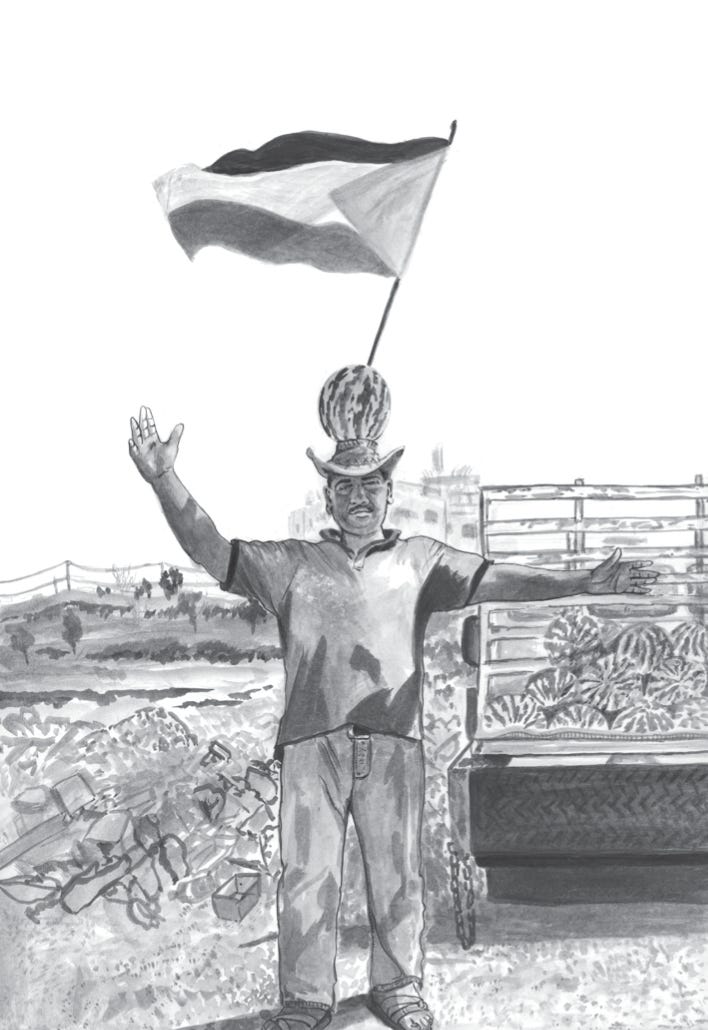
Around two decades later, in 2007, another artist, Khaled Hourani, de- signed ‘Watermelon Flag’ — a minimal, slightly tilted, and striking de- piction of a slice of watermelon on a bright white background. With the piece, Hourani intended to “commemorate the legacy of resistance to the prohibition of the Palestinian flag.”5 After it was featured in the Subjective Atlas of Palestine project, the symbol took on new life. During the 2021 Palestinian uprisings, the flag, along with the watermelon itself, became a symbol of resistance that was seen around the world.
THE PEOPLE’S WATERMELON
This history and context make clear the liberatory potential of a “watermelon solidarity.” What might a watermelon solidarity look like? I think that it is made up of equal parts collective action and collective joy, grounded in communalism and cooperation. We can look to the Indian Springs Co- operative, founded 1964. One of the more successful agricultural cooperatives, it was established by African American farmers demanding better pay for their watermelons. One of its founders, Ben Burkett, has long practiced watermelon solidarity. Not only is he active with La Via Campesina, but Burkett also helps with a local elementary school’s yearly Watermelon Day event. The Experimental Farm Network’s offering of the Jadu’i seed is an additional example. On the EFN website, the closing line of the seed description reads “when you order these seeds, know that they come with a heavy responsibility.”
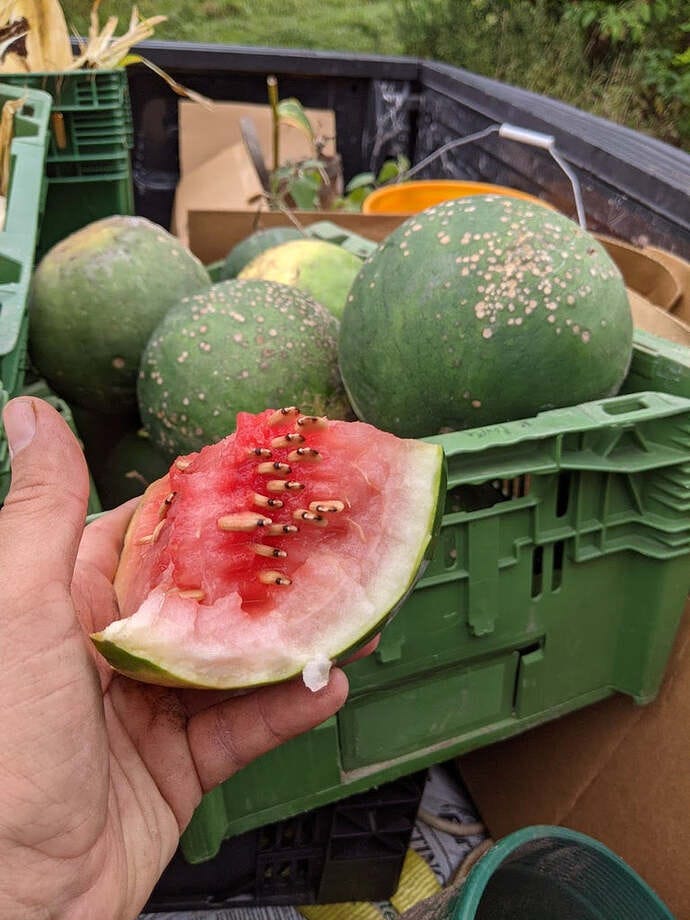
This summer we grew the Jadu’i watermelon in our garden in northeastern Georgia. Despite a genetic heritage rooted halfway across the Earth, the Jadu’i produced better than other varieties we planted, gifting us numerous tasty green globes. In the end though, we wound up with just a few big ones that are still not likely their historic expression. But we will try next year again with the seeds we saved from the fruits, joining others to raise awareness and a good crop. In the meantime, we have had fun eating these watermelons with our loved ones. In fact, it is my experience that the communal eating of watermelon frequently elicits joy, perhaps more than any other fruit. And despite the introduction of personal-sized types in recent years, watermelons remain a predominantly large fruit best cracked open and enjoyed with other people. Next year, when we plant these under weirding skies, we will consider it an act of solidarity, caretaking, and jubilee.
This piece appeared originally in the 2023 Earthbound Farmer's Almanac.

William Black, “How Watermelons Became Black.” Journal of the Civil War Era, Vol. 8, No. 1 (March 2018), pp. 64-86
Akiko Ochiai, “The Port Royal Experiment Revisited: Northern Visions of Recon- struction and the Land Question.” The New England Quarterly, Vol. 74, No. 1 (Mar., 2001), pp. 94-117.
Vivien Sansour and Alaa Tartir. “Palestinian Farmers: A Last Stronghold of Resistance.” Al-Shabaka: The Palestinian Policy Network. July 1, 2014.
Alexandra Chaves, “How the watermelon became a symbol of Palestinian resis- tance.” The National. May 30, 2021. https://www.thenationalnews.com/arts/how-the-water- melon-became-a-symbol-of-palestinian-resistance-1.1230806
“Watermelon Flag.” https://disarmingdesign.com/product/watermelon-flag/