
Canteens
Uprisings & Communal Cooking, by a Deep Food participant

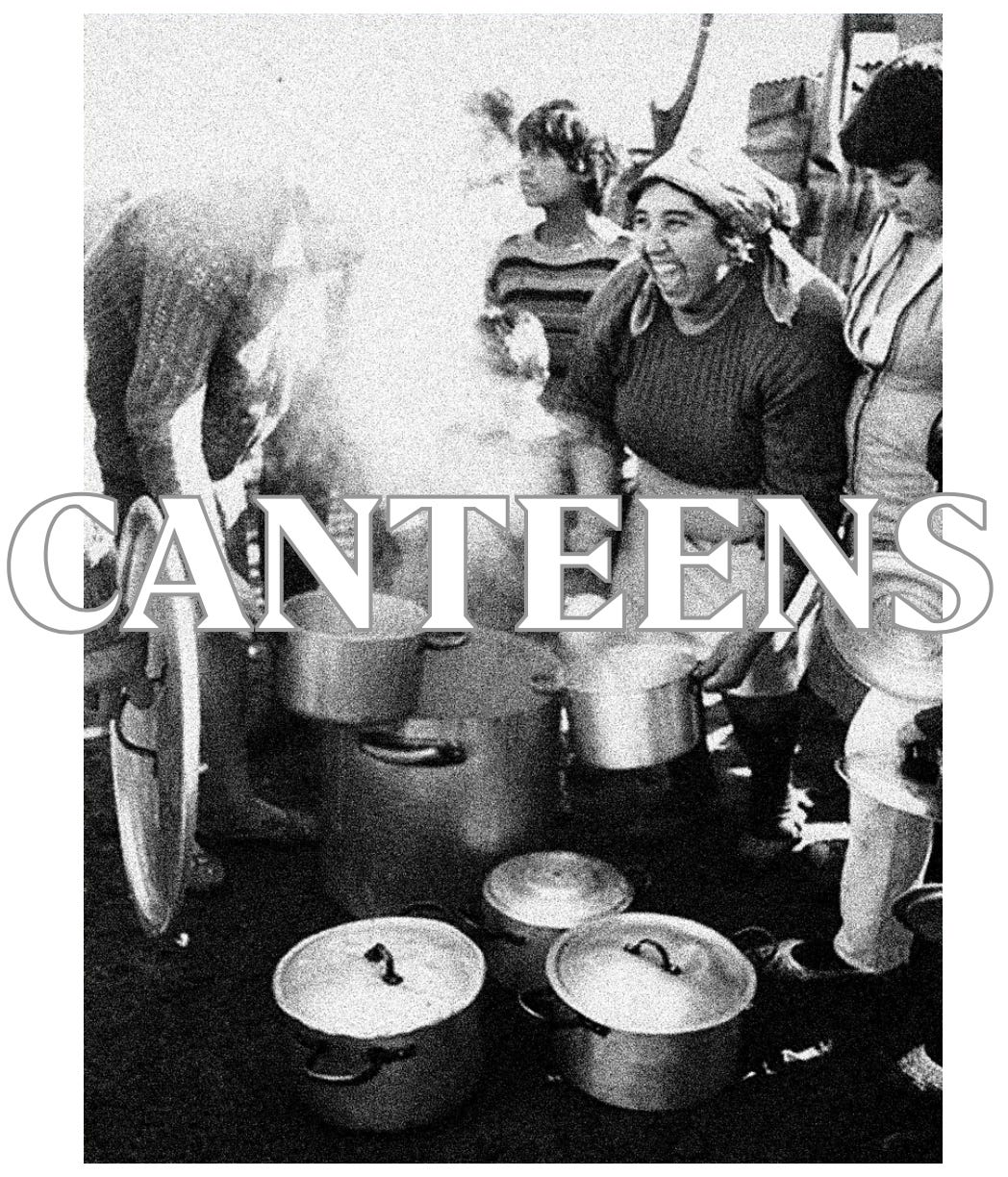
Starting in 2006, there’s been a global cycle of uprisings that’s challenged global capitalism and our world’s rulers. The real opening for this sequence was in Oaxaca City in 2006 which has been called the Oaxaca Commune. Starting in Oaxaca, one of the characteristic dimensions of these uprisings has been that they’ve had to take collective charge of the problems of social reproduction, which is to say that after an initial period of uprising (potentially looting grocery stores, et cetera), it becomes key for revolutionaries, alongside the people in a city that has risen up, to organize feeding each other and sustaining the movement in a very logistical way. While they’ve been called different things in different countries around the world, basically the word for this practice is “canteen.”
The canteen is an organized, collective kitchen that is freely available for use by anyone who comes through. It tends to produce large amounts of food, both for residents in general and for active participants in these uprisings, addressing the question of hunger and making sure that the instability imposed on the political system does not become an instability for the people, in the form of hunger. Canteens also tend to become organizing spaces – ranging from the experience of the ollas comunes (literally ‘communal cooking pots’), the collective kitchens of Chile in Santiago, to the university based canteens that have functioned for years in Quebec, including The People’s Potato at Concordia and Midnight Kitchen at McGill (both are places of daily organizing throughout the school year but also are loci of organizing during strikes).
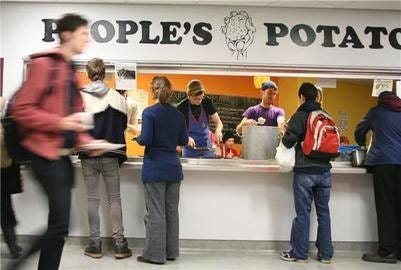
So not only is this a space that addresses the belly in the most basic way, making sure that people aren’t hungry, it can also become a space of political contact between farmers and growers who want to support uprisings due to their shared grievances and other urban participants. That’s been the case, for example, at canteens during the movement against pension reform in 2016 in France, when farmers in the autonomous zone (called the ZAD) delivered tractor loads of potatoes and other foods to the canteens that were feeding both young people and older trade unionists who were involved in strikes and blockades. Kristin Ross describes how this unfolded at an even larger scale in the same region during the May 1968 revolt, when farmers fed the Nantes Commune.
I had a life-changing experience during the insurrection in Greece. Following the murder of Alexis, a young comrade on Dec. 6, 2008, the entire country rose up against police violence and the theft of their future by what was later called “the Troika” of EU capitalist institutions that were imposing austerity in Greece. During this revolt, not only were most police stations attacked or destroyed, but many of the country’s banks and grocery stores were also sacked and destroyed. So at some point, especially in the areas most convulsed by the insurrection, the canteens that were set up, such as in the core occupied spaces of Athens and Thessaloniki, were absolutely central to the social space and the maintenance of the insurrection.
I participated in the occupation of the Economics School in Athens, where even as food stores were emptied out across the country, the canteen was open most hours of the day, with hundreds of people passing through and eating as if they were in a capitalist cafeteria but with- out any of the barriers or alienation – and basically as a space of rest or recuperation between clashes. Even on the very last days when the insurrection faced this fundamental contradiction, which was that the country, due to its paralysis by the people rising up, was running out of food, the canteen continued to serve – even when it was just small slices of feta cheese. I remember the taste of that thin slice even now. Even amid scarcity, you could go through the line and still be able to eat something.
This was a very beautiful kind of moment and way to think about the spaces we create together during moments of rupture. It also speaks to the fundamental contradictions of our era – the canteen and these spaces of social reproduction are absolutely key to revolutions, and yet if we are not breaking out of the barriers imposed by the capitalist economy, we will suffer limits inherited from a food system built around the profit motive and not around meeting people’s needs directly. We have to use these experiences as impulse to deepen our experiments building food autonomy.
This piece appeared originally in the 2025 Earthbound Farmer’s Almanac.

Fascinating! Thanks for sharing. Do you know of any resources in English that detail how to organize and set-up a "canteen?"