
Beyond the Levee
Fugitivity, Reciprocity and New Orleans after USACE

The inhabitants of so-called New Orleans live as a constant reminder of the stakes of building a civilization at odds with the enormous powers of the Mississippi River, the Gulf of Mexico, the skies, the marsh and the swamp. These powers are both life giving and life taking. Colonists and capitalists frightened of the latter sought to devise a scheme to protect themselves and their industrial interests. A year before the “founding” of New Orleans, they set to the task of constructing levees to keep the river out of their new development. In doing so, the colonists sought to violently establish linear time in a place that had never experienced such nonsense. This mile long wall along the river was a catastrophic failure in the face of a flood of significant magnitude by measure of recent indigenous memory. The year 1718 acts as a point of reference with which to orient progress from. A beginning from which all horizons, no matter how malevolent or benevolent, project from.
As the cycles of the rivers’ rising waters and the hurricane furies of the Gulf sought to remind these new permanent residents, the natural world would not be tamed by the dogma of progress. Well known and respected by the lands and waters’ original inhabitants, the gift of life here is a reciprocal one. One where giving and taking is mimicked by the form of the water rising up the rivers’ banks and the bayous’ sloughs. This is a lifeway that acknowledges cycles and difference therein, the lifeway of Bulbancha, that place without borders, colonized time and definition. From where we are today, we could say “that which existed before New Orleans” and many would say still exists here among us.
In contrast, the world being constructed by settlers aimed to deny these cycles and enforce a stasis. With the natural world fully subdued, the colonizer was afforded the comforts necessary to replace reciprocity with transaction. Respect for the gift was put aside by the supremacy of paper money, taking what was needed put aside for extraction and efficiency. As pipelines, oil derricks and canals popped up all over the land and sea, the river was leveed, the backswamp drained and floodwalls reinforced. The functions of extraction, logistical flow and housing markets were secured by the proclaimed function of protection of the vulnerable population.
In the 300 something years of linear time that has passed since Bulbancha was colonized, an abundance of rich cultures have grown and flourished in spite of settler colonialism and the slave plantation monoculture the region’s wealth rests on. What has come to be known as “American culture” comes from the drumming and dancing in Congo square, gumbo cooked in the shanty homes of enslaved families and the African woodworking techniques that built the french quarter. Every year throngs of tourists descend upon this most creole of cities to see that culture, giving veracity to the claim that there is something here to be protected.
We are forced to beg for our protection. As the city sinks in some places over 10 feet below sea level and the swamps and marshes surrounding the city have been pillaged and allowed to wash away, we can seemingly only demand higher walls to protect us from the onslaught brought on by progress. In a unified chorus, New Orleanians of all stripes ask the state and its army corps of engineers to continue to guarantee protection, that promise endowed upon those whom the state considers citizens. But even the most generous progressive forecasts don’t include protection for perpetuity. This culture of begging endangers us all but it is not our only option.
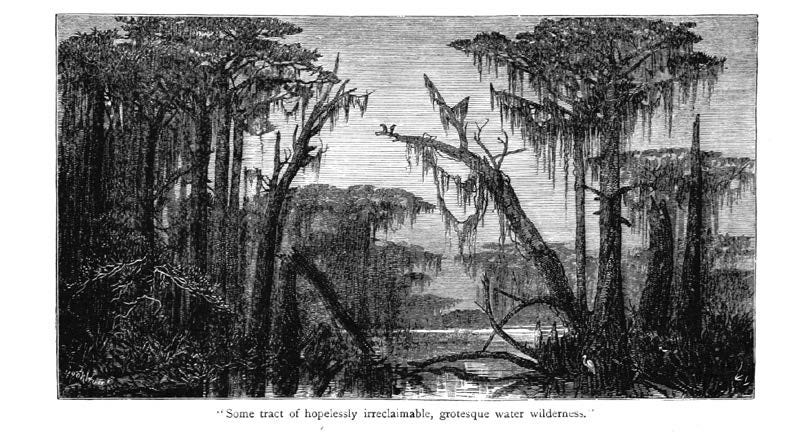
Life outside of state protection --and often in spite of it--has long been a matter of survival. Deep in the swamps and marshes, cultures of maroon resistance and fugitivity flourished in combat with and desertion from the social death of chattel slavery. This legacy lived on by the waters of Lake Borgne in the autonomous village of St. Malo, named in honor of the maroon bandit by Filipino mutineers. Poor New Orleanians lived off (and over) the lake, squatting in the backswamp well before they were evicted for the construction of parks, wealthy housing developments and the very floodwalls put up to supposedly protect them. As concrete was poured over the debris of the homes of these lakeside fishers, Isleño trappers fired guns upon the closing of the marshland commons by the St Bernard parish government.
As the ravages of modernity grow louder and the tenor of the Mississippi’s yearly floods crescendo, there is no levee they can build that will achieve environmental stasis and preserve linear time. While the city’s floodwalls keep us somewhat dry sometimes, they obscure what’s on the other side. This keeps us feeling safe in ignorance as the water gets higher, and robbed of imagination, unable to dream a way to live in cycles with the water that has created and taken for time eternal.
It is only a matter of time before these walls fall again and linear time washes away. Once more, our survival is dependent upon the water and the bonds born of fugitivity.
In the not so distant future, the river lives.
The floodgate holding the river out of its desired path gave way years ago, causing disastrous flooding along the Atchafalaya River. Decades of alarm bells from engineers and scientists never elicited a policy response to allow the Mississippi River out of its prison in a controlled manner. A riverine estuary ebbed and flowed by Bulbancha. Where land had already been forming at a faster rate than anywhere on Earth, the Atchafalaya delta began to grow by several orders of magnitude. The creative and destructive powers of the River returned in full force. As colonial control slipped, the lands and waters entered a backloop, sending ecosystems into disarray, causing new ecologies to emerge, towns to unsettle and new cultures to be forged.
Although the changing climate has made rains more intense in the watershed, the river’s flood crests no longer reach heights that could only be engineered by miles of walls denying it access to its floodplain.
Over years of levees crumbling and never being rebuilt, some communities along the river began to build further from its potential wrath while others chose to stay close to its bounty, building in manners that could accommodate its waters. While some communities have been slower to relinquish their protection, others saw the benefits of letting the rivers waters to return to the fields and either demolished the levees or built check dams into them to allow the waters through occasionally. Eroded fields that had suffered for decades of intensive farming were replenished by minerals and organic matter that the water brought. A network facilitated by riverine communities was established to communicate river conditions and share resources. Areas that flooded in a given year received support from communities upriver and downriver that remained dry.
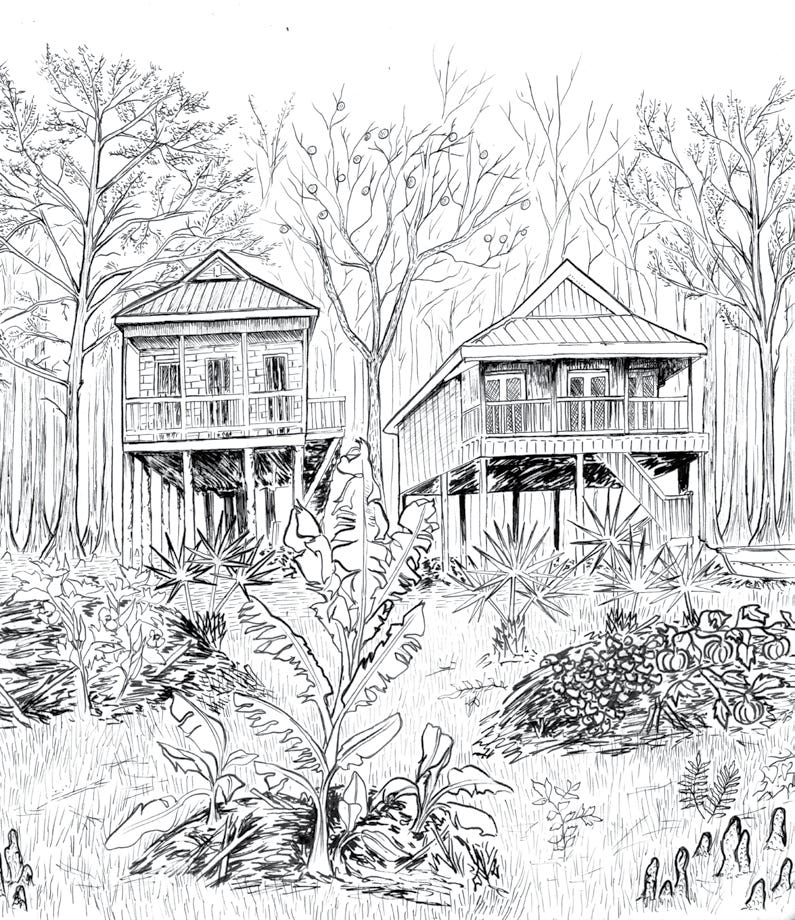
The streets of Bulbancha are dense with live oaks, pecan, banana and persimmon. Perennial crops grow along the neutral grounds where elders tell stories of when there was a Port of New Orleans. The population swells in the winter and recedes in the summer, many inhabitants adopting a seasonal migration away from the dangers of hurricane storm surge. Those living in the back swamp travel almost entirely by boat and dwell in houses on stilts. These year round residents live off the waters and gardens, knowing that in reciprocity there is both giving and taking.
This piece appeared originally in the 2022 Earthbound Farmer's Almanac.
